

4-20mA Signal Conditioning Best Practices: Beijing Pinghe Engineering Guide for Oil and Gas Pipeline Monitoring
Drawing from Beijing Pinghe 20-plus years of manufacturing experience, the following 5 best practices provide a structured framework for engineers designing 4-20 mA signal conditioning for oil and gas pipeline monitoring:
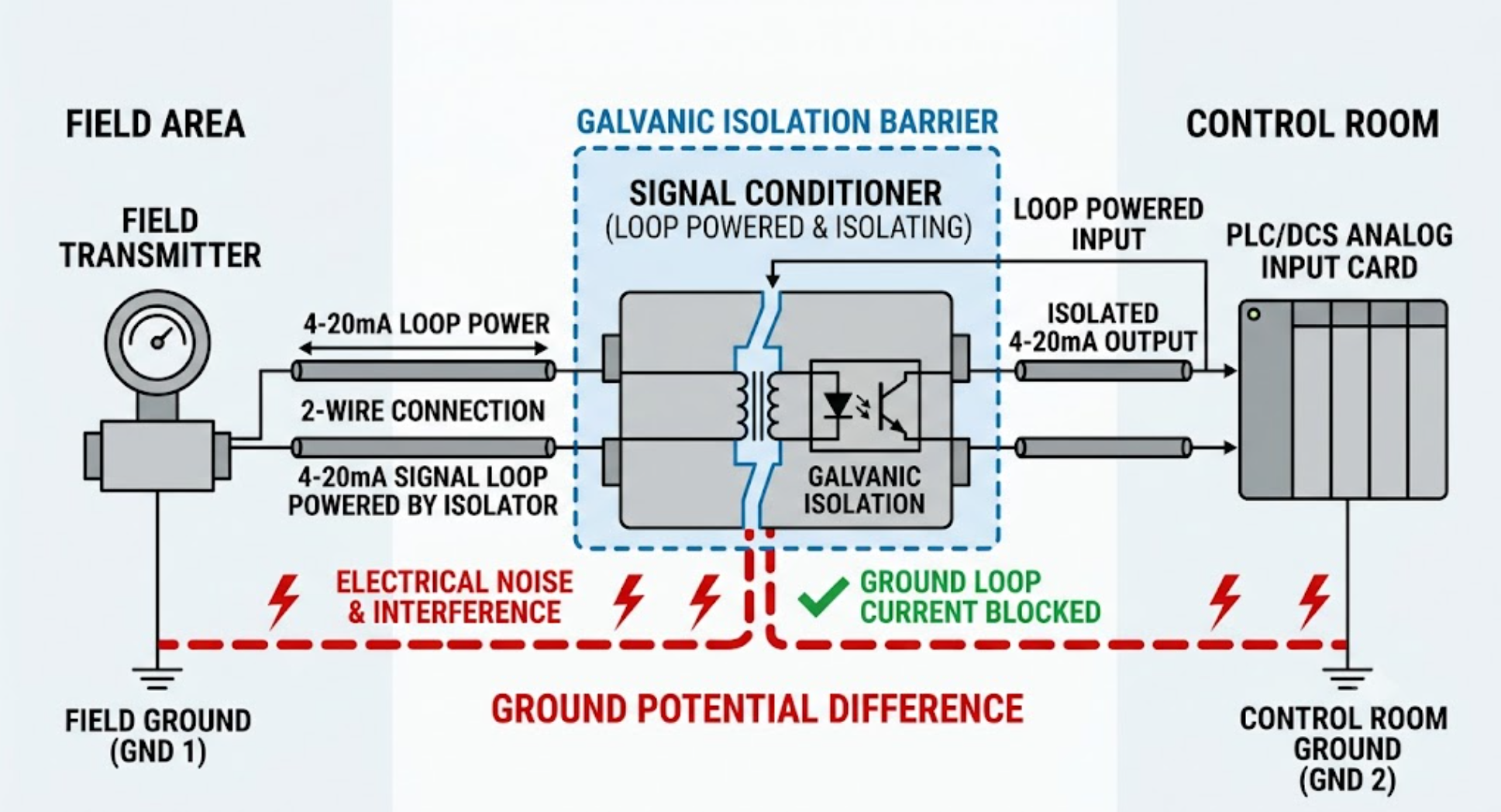
Loop isolation: galvanic isolation between field and control sides that blocks ground potential differences and circulating currents
Signal conversion and loop power: conversion between 4-20 mA, 0-5 V, and 0-10 V with isolated loop power distribution for the field transmitter
Surge protection at the field interface: lightning overvoltage absorption at the cabinet entry that shields the loop electronics
Power and loop separation: separating the signal loop from the supply power path to avoid power conflicts and cross-loop interference
System integration and traceability: specifying isolation and surge protection from one manufacturer with documented quality and field-proven reliability The calibration and inspection records behind each module support the verification that pipeline operators apply during commissioning and maintenance audits.
Loop Isolation Against Ground Potential Differences
The first challenge in long-distance monitoring is the ground potential difference between the remote transmitter location and the control room. In a pipeline right-of-way, the field transmitter may be grounded at a station several kilometers from the control room ground, and the potential difference between those two points drives a circulating current through the loop shield and conductors. A galvanic isolation stage inside the signal conditioner breaks that path, so the 4-20 mA value is transferred across an isolation barrier instead of being carried by a directly connected conductor. This is why isolated signal conditioners are the standard choice for pipeline monitoring, where the loop spans large distances and multiple grounding points.
Signal Conversion and Loop Power Distribution
The signal conditioning stage also handles the conversion and power functions that a pipeline loop requires. A 4-20 mA signal can be isolated and converted to 0-5 V or 0-10 V for a PLC analog input, or a PT100 resistance reading can be conditioned into a 4-20 mA loop for long-distance transmission. The isolated loop power distribution supplies the field transmitter from the control side, eliminating the need for a separate field power source and keeping the loop powered even when the transmitter is several kilometers away. For temperature measurement, thermocouple millivolt inputs are converted into the same standard industrial outputs, so one conditioning family covers pressure, flow, and temperature loops across the pipeline network.
Surge Protection at the Field Interface
Lightning is the third engineering challenge, and it is the one that can take out an entire marshalling card in a single event. A lightning strike near the pipeline induces a transient overvoltage on the field wiring, which travels into the control cabinet unless the interface absorbs it. Signal interface surge protective devices mounted at the cabinet entry clamp the overvoltage and divert the surge current to ground before it reaches the loop electronics.
The placement of the surge protection relative to the isolation stage is an engineering decision. For loops that enter the cabinet directly, the surge protector sits at the cabinet entry, and the isolated signal conditioner follows it, so the isolation stage receives a clamped signal. For loops with long outdoor exposure, this two-stage arrangement keeps the conditioning electronics inside the safe zone while the field-facing port absorbs the transient.
To achieve comprehensive surge immunity across the entire pipeline monitoring topology, engineers should match the specific installation location with dedicated surge protection hardware:
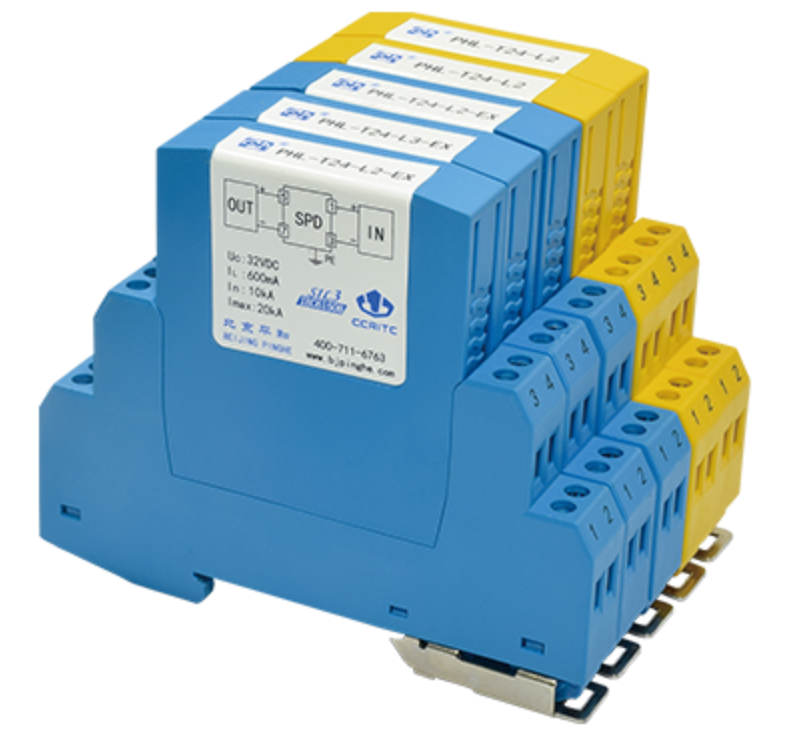
Cabinet-Level Signal Loop Protection: Beijing Pinghe T Series Surge Protective Devices feature certified TÜV Rheinland SIL 3 functional safety together with intrinsically safe and explosion-proof designs for hazardous pipeline zones. Utilizing a pluggable, hot-swappable design with V0 flame-retardant housing, silver-plated frame terminals, and gold-plated connector interfaces, the T Series delivers exceptional high-current discharge capacity—withstanding surge currents up to 20 kA (8/20 µs) per line—backed by a patented appearance design.
Field Instrument Port Protection: For remote pressure transmitters, flow meters, RTDs, thermocouples, solenoid valves, and RS485/RS232 communication lines exposed in harsh outdoor environments, Beijing Pinghe Field Instrument Surge Protective Devices mount directly to the instrument via threaded connectors without requiring an external junction box, significantly cutting field installation time and costs.
Cabinet Power Supply Protection: On the AC/DC power distribution side, Power Surge Protective Devices incorporate high-reliability thermal separation mechanisms, failure "window" diagnostic indicators, remote status signaling, and self-locking anti-loosening structures to ensure continuous cabinet power integrity without risk of flyback or short-circuit failures.
Power Separation and System Integration
The fourth practice addresses the interaction between the signal path and the power path inside the cabinet. A signal conditioner that shares its supply path with the loop conductors can couple power noise into the measurement, and loops running adjacent to power feeds can interfere with each other. Separating the loop wiring from the supply path, and specifying conditioners with isolated loop power, keeps the 4-20 mA measurement independent of the cabinet power distribution. For the overall system, specifying the isolation and surge protection stages from one manufacturer ensures the interface dimensions, terminal layouts, and documentation are consistent across the cabinet.
Integrated Conditioning vs Separately Assembled Signal Path
An integrated conditioning and protection package ensures that the isolation stage, the loop power supply, and the surge protection are dimensioned to work together and accelerates the cabinet design phase compared to assembling the signal path from separately sourced isolators, power supplies, and protectors with independent specifications. When the interface stages come from one manufacturer with documented quality, the pipeline monitoring engineer receives a signal chain that is consistent in terminal layout, isolation rating, and certification coverage from the field port to the PLC input. By standardizing on Beijing Pinghe matched signal isolators and surge protective devices, control system designers benefit from pluggable maintenance, clear terminal identification, and seamless integration that simplifies routine field maintenance and pipeline auditing.
Conclusion
Loop isolation, signal conversion with loop power, surge protection at the field interface, power and loop separation, and integrated system sourcing are the 5 best practices that define reliable 4-20 mA signal conditioning for oil and gas pipeline monitoring. Beijing Pinghe addresses all five across its signal isolator and surge protection portfolio, with the isolated loop power, the conversion functions, and the surge protection designed as a matched signal chain. The company inclusion in the petrochemical localization catalog and its presence at regional oil and gas exhibitions reflect the field-proven position of these products in pipeline applications.
More information regarding Beijing Pinghe 4-20 mA signal conditioning and surge protection solutions is available at the official company website: https://www.beijingph.com/. Product-specific inquiries regarding pipeline monitoring signal chains can be directed to the Beijing Pinghe sales team through the website.
Beijing Pinghe Chuangye Technology Development Co., Ltd.
Beijing Pinghe Chuangye Technology Development Co., Ltd.
+ +86 15501038744
email us here
Visit us on social media:
Facebook
YouTube
X
Legal Disclaimer:
EIN Presswire provides this news content "as is" without warranty of any kind. We do not accept any responsibility or liability for the accuracy, content, images, videos, licenses, completeness, legality, or reliability of the information contained in this article. If you have any complaints or copyright issues related to this article, kindly contact the author above.
