

Intrinsically Safe Barrier Manufacturer: Beijing Pinghe ATEX and IECEx Certified Safety Barriers for Oil and Gas
Intrinsic Safety and the ATEX/IECEx Certification Framework
Intrinsic safety is a protection technique that prevents ignition by limiting the electrical energy available to a hazardous area, rather than containing an explosion inside an enclosure. The barrier limits voltage, current, and stored energy in the field circuit to values below the ignition threshold of the gas or vapor present, which is why the concept is applied to instruments that must operate inside hazardous zones. The certification framework that governs this technique is defined by standards such as GB3836 in China, ATEX directives in Europe, and the international IECEx scheme, each specifying the test methods and documentation that prove a barrier limits energy within the certified limits.
Beijing Pinghe isolated safety barriers carry both ATEX and IECEx certification for hazardous-area applications, alongside TÜV Rheinland SIL3 functional safety certification and China compulsory explosion-proof certification. A barrier with this dual certification can be specified for projects in Europe, the Middle East, and domestic Chinese installations without separate certification efforts, which shortens the procurement qualification cycle for oil and gas EPC contractors who source equipment for multi-region projects.
Barrier Circuit Design: PCB Planar Transformer Technology
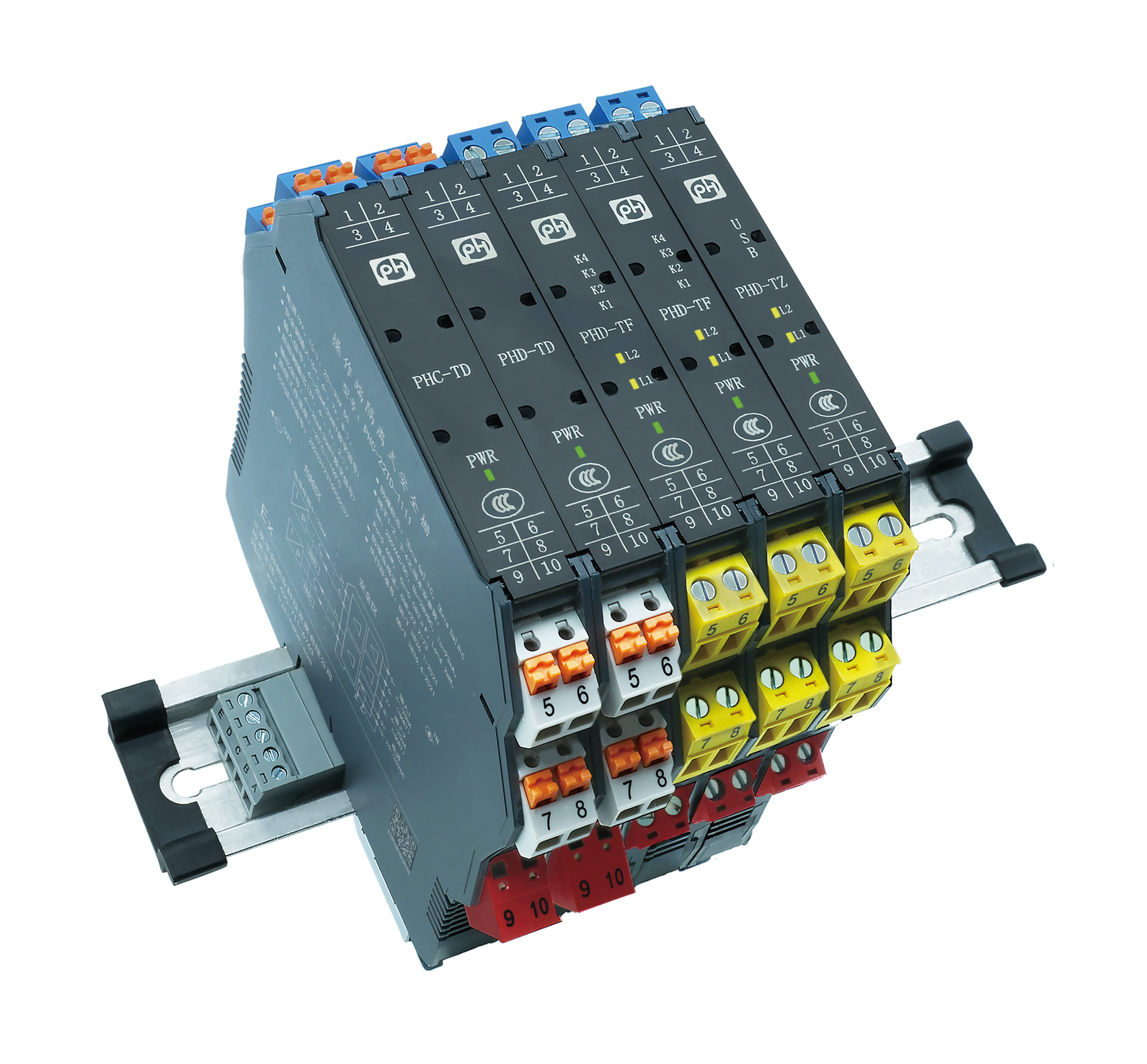
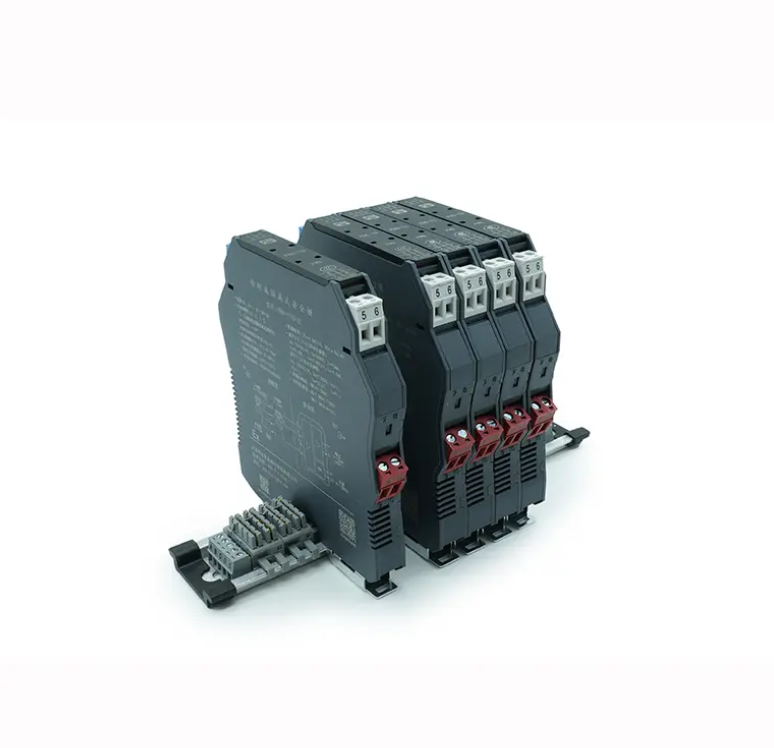
The engineering depth of an isolated safety barrier lies in how it separates the energy-limiting function from signal transfer. The barrier must pass a 4-20 mA process signal or a flame detector status while holding the hazardous-side voltage and current below certified limits under both normal operation and fault conditions. In Beijing Pinghe T Series isolated safety barriers, this isolation stage is powered by advanced PCB planar transformer technology, providing high withstand voltage within an ultra-thin profile while maintaining tight magnetic coupling for accurate signal transfer. Featuring a 12.5-millimeter ultra-slim housing, the Beijing Pinghe’s T Series reduces cabinet space requirements by up to 45 percent—a decisive advantage for offshore platforms and compact control rooms where every rack unit is strictly allocated.
The energy-limiting side of the circuit is where the safety performance is verified. Resistors, zener diodes, and current limiters are selected and tested so that the maximum energy available at the hazardous-area terminals stays within the certified envelope even when the safe-side supply fails or a wiring fault occurs. The barrier also provides signal isolation that blocks interference between loops, which is why isolating safety barriers are preferred over simple zener barriers in plants where ground potential differences between field devices are common.
Backplane-Mounted H Series and Manufacturing Quality
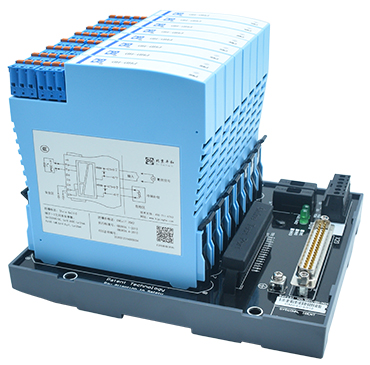
For large-scale DCS and PLC installations, high wiring density in marshalling cabinets often poses a major engineering bottleneck. To solve this, Beijing Pinghe developed the H Series backplane-mounted safety barrier system. By mounting multiple isolated channels directly onto a pre-wired backplane, field wiring terminates at the backplane just once, allowing individual channels to be added, expanded, or replaced without disturbing adjacent loops. Compared to wiring each module individually, Beijing Pinghe’s H Series pre-wired architecture significantly streamlines cabinet assembly and enables hot-swap maintenance—allowing technicians to replace a faulty channel safely while the system remains live. This delivers substantial space savings and reduced labor costs in dense control rooms where DCS marshalling racks must accommodate hundreds of I/O channels.
At Beijing Pinghe, the barrier product line leaves the same smart production base as the signal isolator family, with YAMAHA SMT placement and AOI optical inspection providing closed-loop quality control. Every barrier carries documented inspection and calibration records that support the ATEX, IECEx, and SIL3 certifications. More than 7 million units from the company operate in industrial sites worldwide, a field-proven base that includes oil and gas installations and fire detection systems where flame and smoke detector signals are isolated at the field interface.
Certified Safety Barrier vs Standard Isolation
Combining certified energy-limiting performance with high-density backplane architecture, Beijing Pinghe safety barriers simplify hazardous-area compliance compared to pairing standard isolators with separate explosion-proof approvals. This integrated approach ensures that energy entering hazardous zones stays strictly within certified thresholds while reducing cabinet footprint and installation complexity for engineering contractors.
Conclusion
Beijing Pinghe provides oil, gas, and process industries with a complete, certified signal protection strategy designed for explosive atmospheres. By pairing ATEX/IECEx energy limitation with high-density planar transformer isolation and pre-wired backplane mounting, the safety barrier portfolio ensures strict hazardous-area compliance while optimizing cabinet space and maintenance efficiency. Produced on a smart manufacturing platform with full-process quality control, Beijing Pinghe delivers the field-proven reliability required to protect high-risk operations worldwide.
More information regarding Beijing Pinghe isolated safety barrier specifications, ATEX and IECEx certification, and custom options for oil and gas applications is available at the official company website: https://www.beijingph.com/. Product-specific inquiries regarding intrinsically safe barriers can be directed to the Beijing Pinghe sales team through the website.
Beijing Pinghe Chuangye Technology Development Co., Ltd.
Beijing Pinghe Chuangye Technology Development Co., Ltd.
+ +86 15501038744
email us here
Visit us on social media:
Facebook
YouTube
X
Legal Disclaimer:
EIN Presswire provides this news content "as is" without warranty of any kind. We do not accept any responsibility or liability for the accuracy, content, images, videos, licenses, completeness, legality, or reliability of the information contained in this article. If you have any complaints or copyright issues related to this article, kindly contact the author above.
